Week 9
Polarization in America
Soci—229
A Divided America?–
October 27th
Updates and Reminders
Midterm Paper
Midterm Paper Deadline
Your midterm papers are now due this Wednesday, October 29th at 8:00 PM.
Updates and Reminders
Response Memo Deadline
This week’s response memo—which has to be between 250-400 words and posted on our Moodle Discussion Board—is due by 8:00 PM tonight.
Updates and Reminders
The Cummings Lecture
Title
Something Between Us
The Everyday Walls of American Life, and How to Take Them Down
Description
Click to Expand or Close
Scroll to access the entire description.
In 2016, Anand Pandian was alarmed by Donald Trump’s harsh attacks on immigrants to the United States, the appeal of that politics of anger and fear. In the years that followed, he crisscrossed the country seeking out fellow Americans with markedly different social and political commitments, trying to understand the forces that have hardened our suspicions of others. The result is Something Between Us, a groundbreaking and ultimately hopeful exploration of the ruptures in our social fabric, and courageous efforts to rebuild a collective life beyond them. Through vivid encounters with Americans of many kinds, Pandian shares tools to think beyond the twists and turns of our bracing present.
Date and Time
Location
Updates and Reminders
If you attend the lecture, you do not have to
submit a response memo tonight.
Are We “Divided?”
Divisions in Cultural and Political Life
A Question
Are we living in a period of political division?
Divisions in Cultural and Political Life
Click to Expand Image
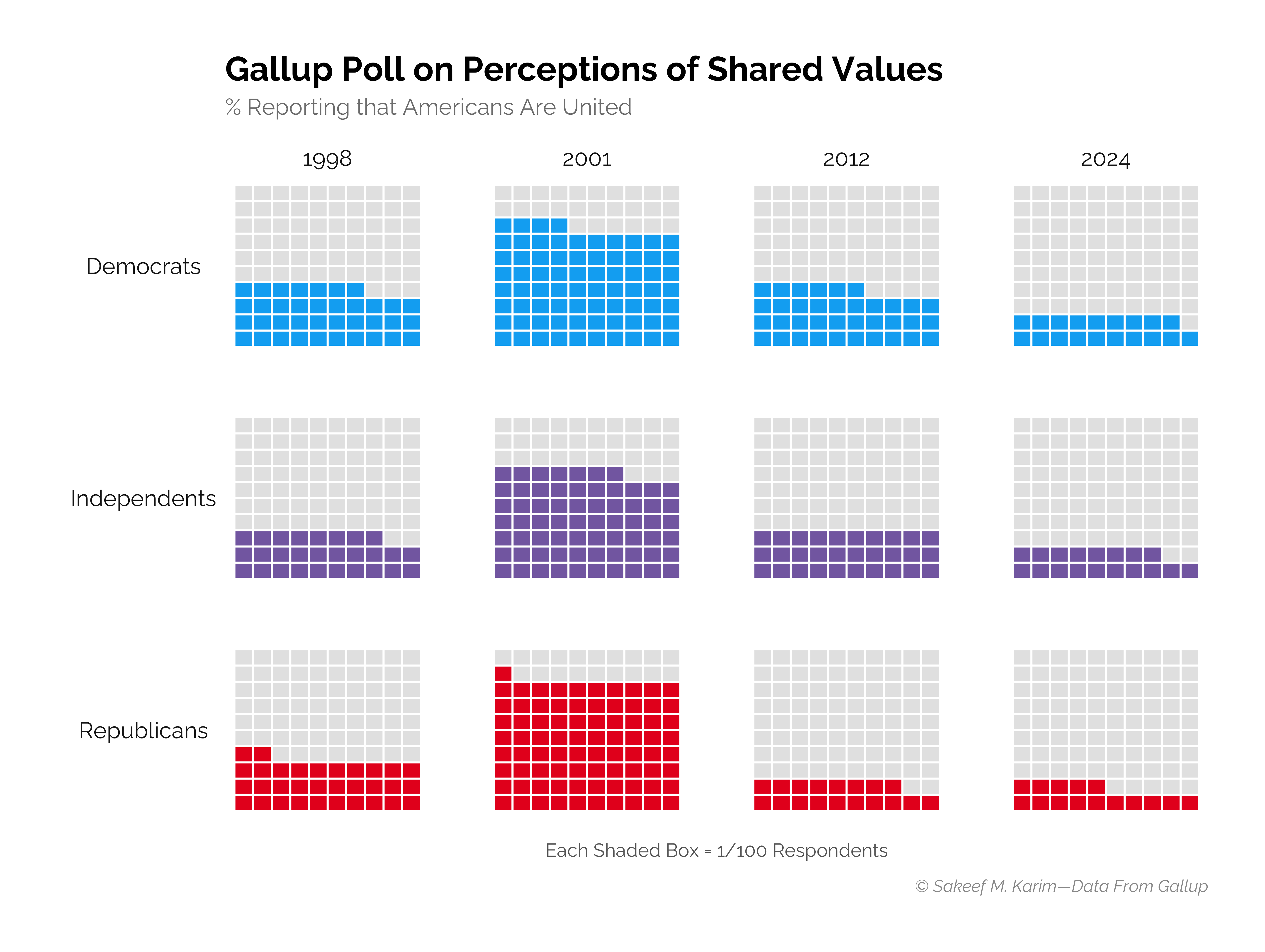
Data Comes From Gallup
Divisions in Cultural and Political Life
Divisions in Cultural and Political Life
Another Question
What concept or population parameter do social scientists use
to measure this divisiveness?
Divisions in Cultural and Political Life
One Answer
Affective Polarization.
Affective Polarization
Tracking Affective Polarization
A Working Definition
[R]egardless of how divided Americans may be on the issues, a new type of division has emerged in the mass public in recent years: Ordinary Americans increasingly dislike and distrust those from the other party … Democrats and Republicans both say that the other party’s members are hypocritical, selfish, and closed-minded, and they are unwilling to socialize across party lines, or even to partner with opponents in a variety of other activities. This phenomenon of animosity between the parties is known as affective polarization.
(Iyengar et al. 2019, 130, EMPHASIS ADDED)
Tracking Affective Polarization
How do scholars measure affective polarization?
Tracking Affective Polarization
The Canonical Measurement Strategy
Inparty_{(0-100)} - Outparty_{(0-100)}
Tracking Affective Polarization
The Canonical Measurement Strategy
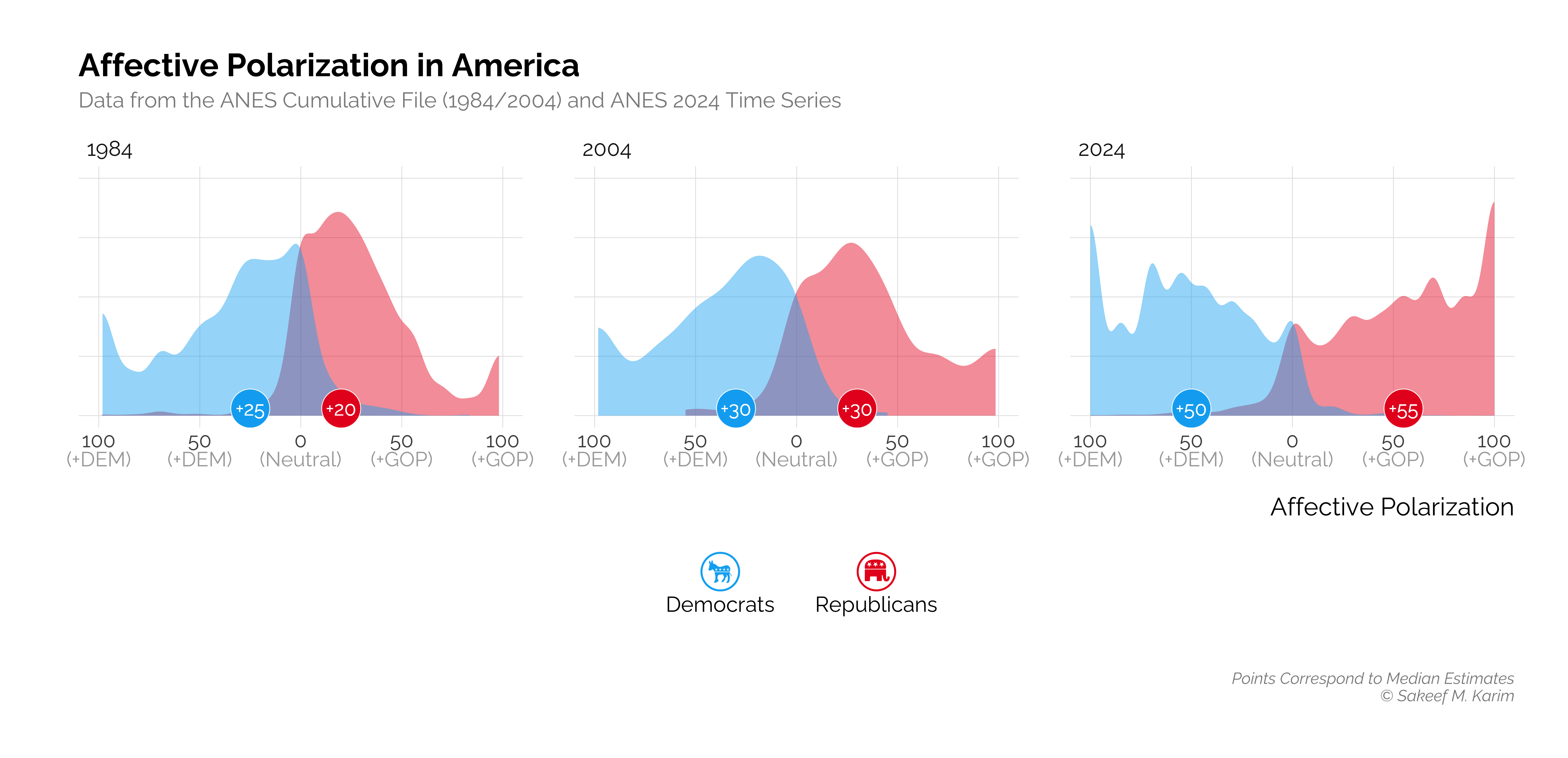
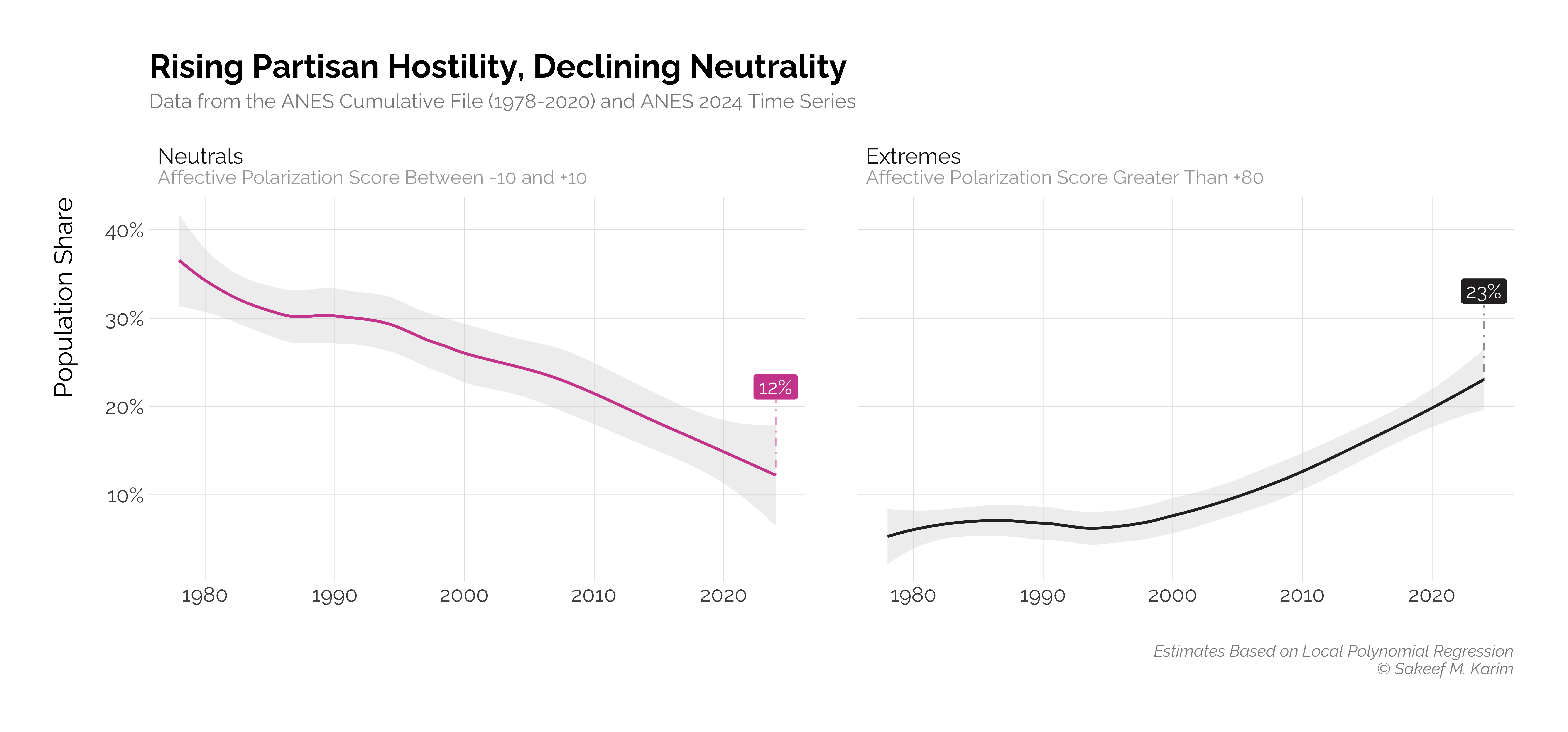
The Extent of Affective Polarization in America
The Macro Context
Click to Expand Image & Launch Gallery
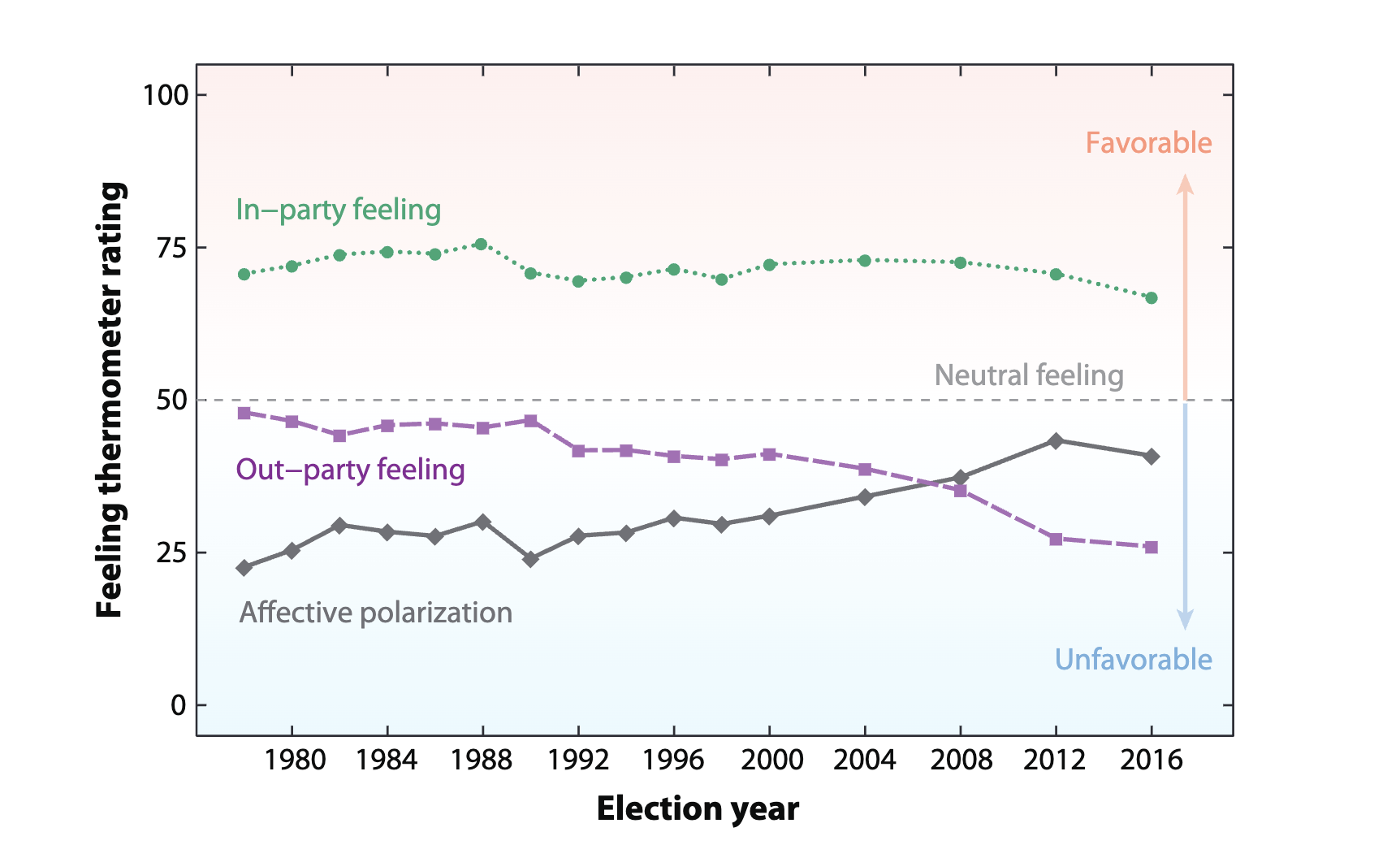
Figure 1 from Iyengar and colleagues (2019).
The Macro Context
Click to Expand Image & Launch Gallery
The Macro Context
Click to Expand Image & Launch Gallery
Group Discussion I
Polarization and Exclusionary Politics
What’s the link between affective polarization and the
politics of exclusion? Discuss in groups of 3-4.
The “Causes” of Affective Polarization in America
Some “Causes”
Iyengar and colleagues (2019) point to a few possibilities:
Partisan Sorting
Shifting Media Environment
Elite Articulation via Political Campaigns
Network Effects
Let’s focus on the highlighted determinants.
Some “Causes”
Partisan Sorting
[I]n the last 50 years, the percentage of sorted partisans, i.e., partisans who identify with the party most closely reflecting their ideology, has steadily increased (Levendusky 2009). When most Democrats are liberals and most Republicans are conservatives, copartisans are less likely to encounter conflicting political ideas and identities (Roccas and Brewer 2002) and are more likely to see nonidentifiers as socially distant. Sorting likely leads people to perceive both opposing partisans and copartisans as more extreme than they really are, with misperceptions about opposing partisans being more acute (Levendusky and Malhotra 2016).
(Iyengar et al. 2019, 134, EMPHASIS ADDED)
Some “Causes”
Partisan Sorting \Rightarrow Social Sorting
As partisan and ideological identities became increasingly aligned, other salient social identities, including race and religion, also converged with partisanship. White evangelicals, for instance, are overwhelmingly Republican today, and African Americans overwhelmingly identify as Democrats. This decline of cross-cutting identities is at the root of affective polarization, according to Mason (2015, 2018). She has shown that those with consistent partisan and ideological identities became more hostile toward the out party without necessarily changing their ideological positions, and those who have aligned religious, racial, and partisan identities react more emotionally to information that threatens their partisan identities or issue stances.
(Iyengar et al. 2019, 134, EMPHASIS ADDED)
Some “Causes”
Network Effects
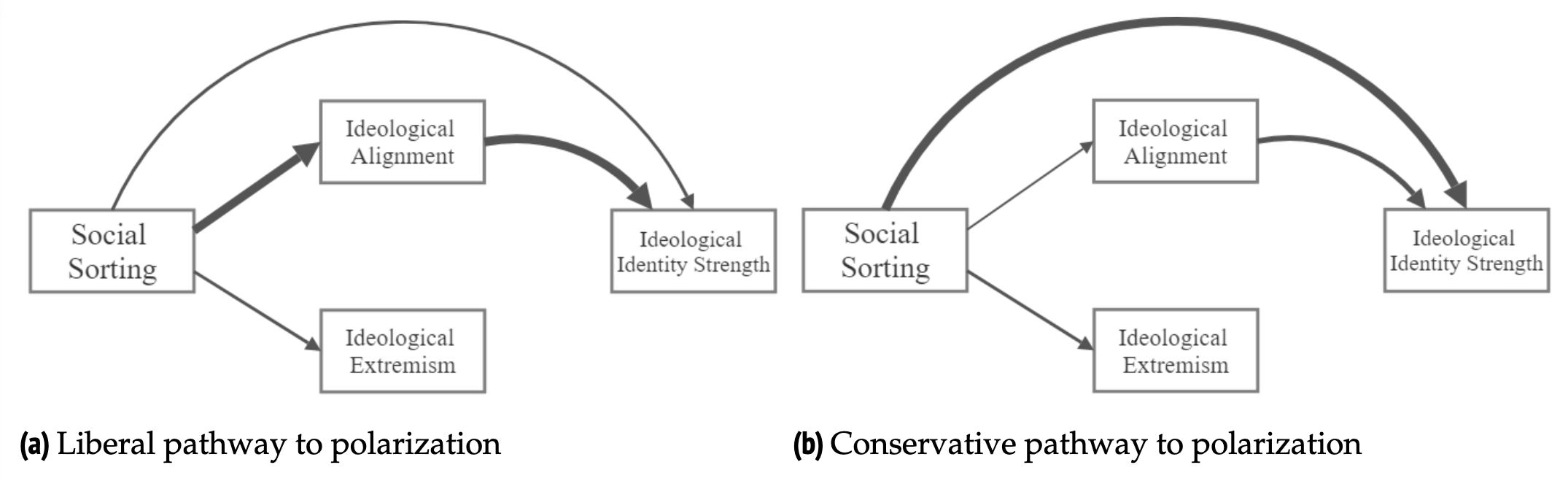
Figure 4 from Rawlings (2022).
Class Discussion
The Consequences of Affective Polarization
In your view, what are some of
the consequences of affective polarization?
Are Americans Polarized On the Issues, Too?
Issue Polarization
So, do we think issue polarization is rising as well?
Issue Polarization
[A]lthough people have become better sorted by party and political ideology, public attitudes on most political issues seem to have remained unpolarized to a remarkable degree … Although knowing someone’s political party or self-described ideology allows us to predict their attitudes with increased accuracy, these attitudes themselves have not become much more strongly aligned with other attitudes, as we would expect in a world of mass polarization … Unlike the political elite, the broader public is composed of large numbers of “ideological innocents” … who espouse cross-cutting and often inconsistent beliefs across political issues.
(DellaPosta 2020, 508, EMPHASIS ADDED)
Issue Polarization
A (Relevant) Sidebar
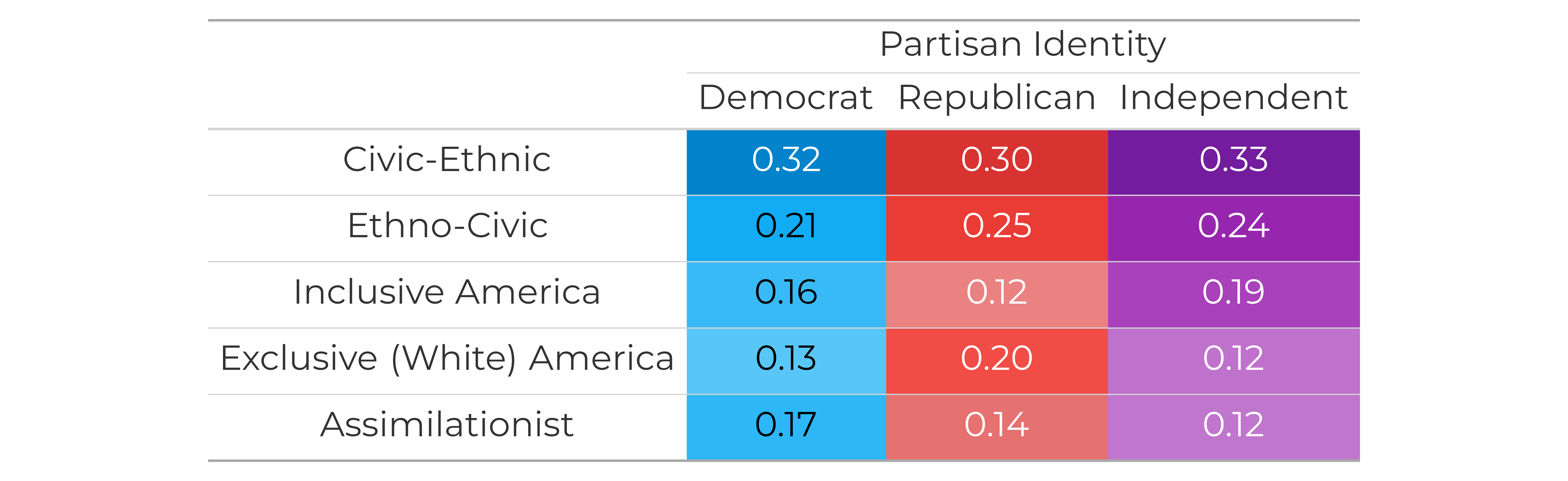
Table 3 from Okura and Karim (2025).
Issue Polarization
Maybe affective and issue polarization are unrelated?
Issue Polarization
Or maybe we’re not seeing the bigger picture.
Group Discussion II
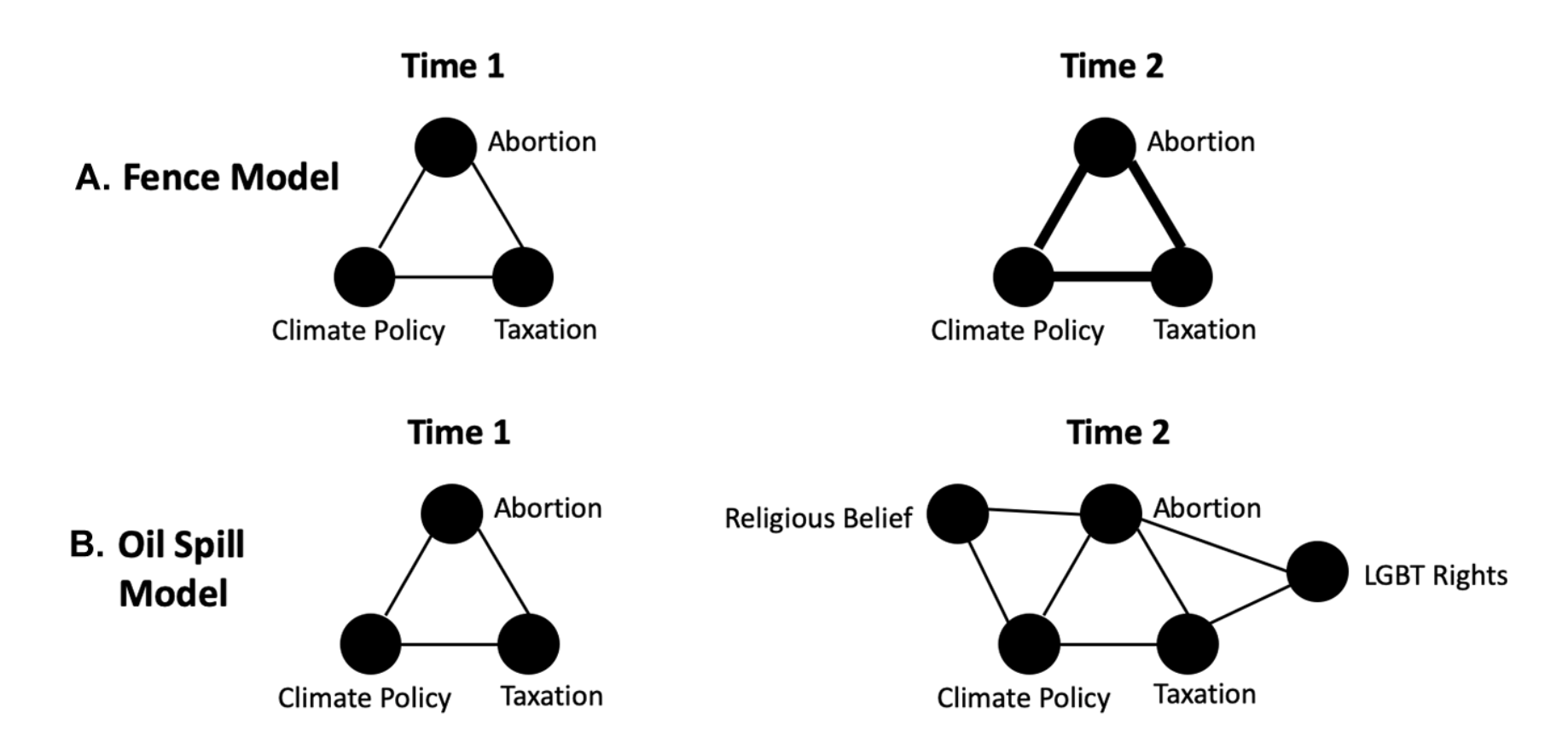
The “Oil Spill” Model
Educational Polarization and the “Culture War”–
October 29th
A Reminder
Midterm Paper
Midterm Paper Deadline
Your midterm papers are due tonight at 8:00 PM.
A Reminder
Final Paper Proposal
Final Paper Proposal Deadline
Your final paper proposals are due by 8:00 PM on Friday, November 21st.
A Reminder
Final Paper Proposal
More details will be provided next week.
A Latent Educational Realignment in America
“College” in a Changing World
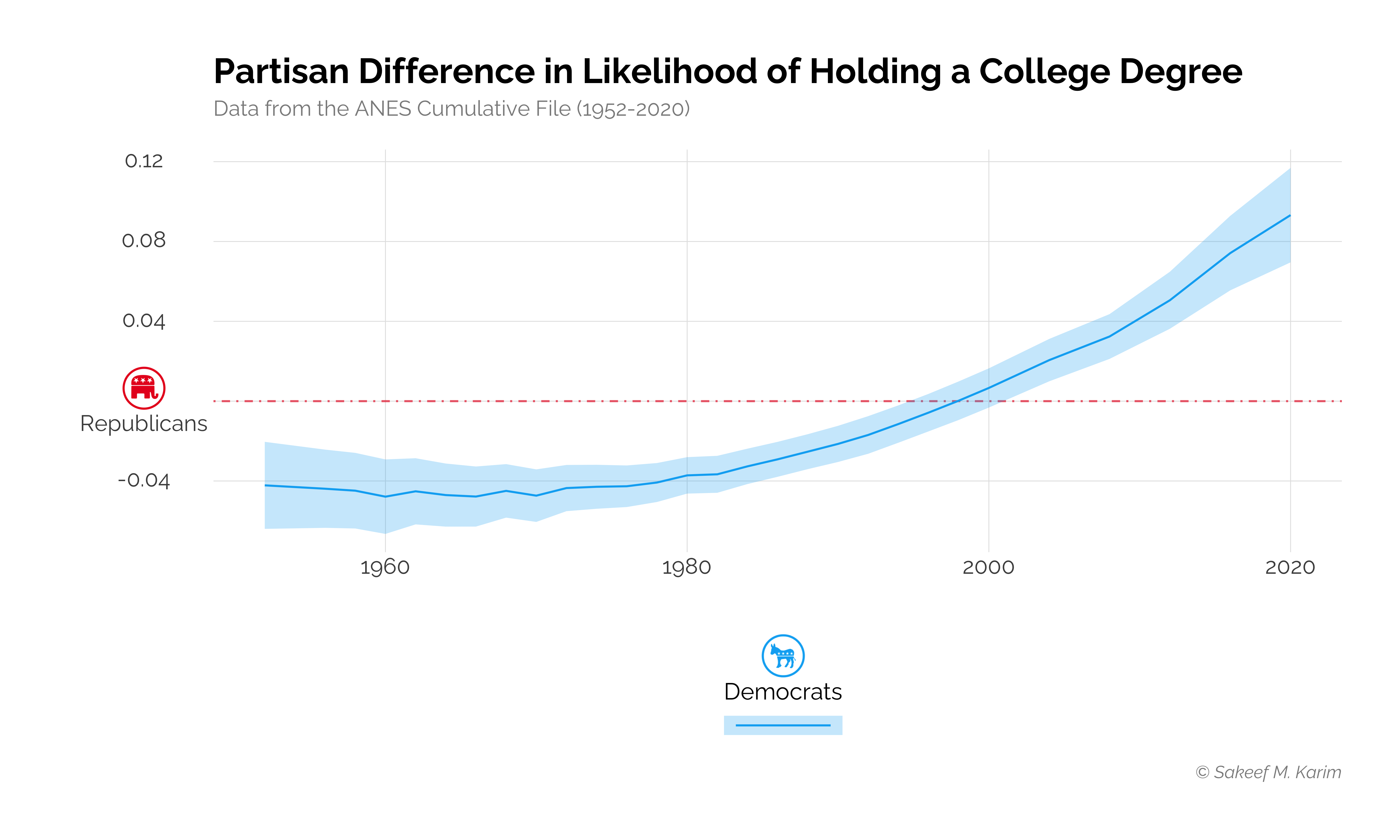
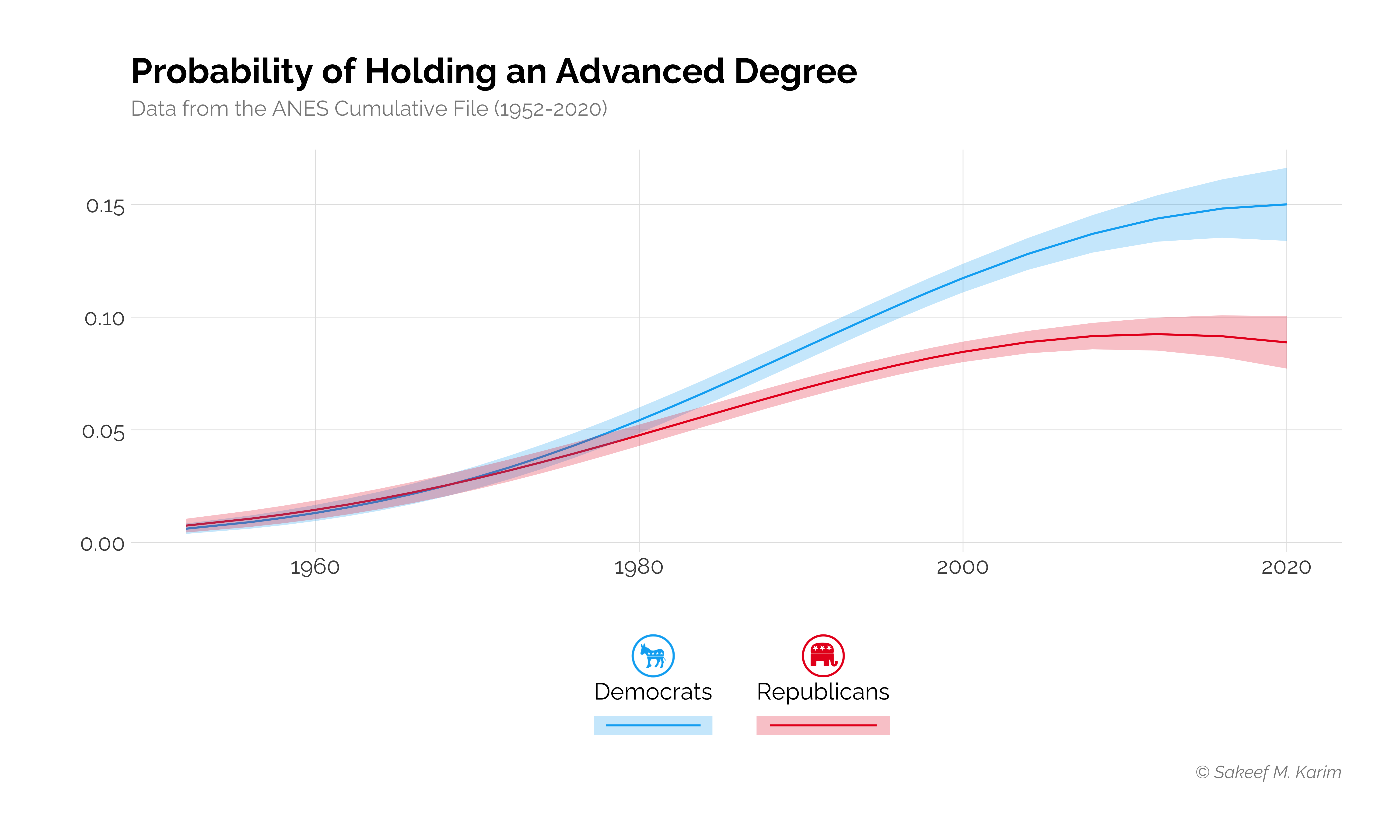
[A] new dimension of partisan conflict has emerged along the lines of formal educational attainment. Republican supporters in the electorate were once a consistently better-educated group than Democrats. But white voters with four-year college degrees have increasingly moved in a Democratic direction over the past two decades, while white voters who did not graduate from college have shifted even more dramatically toward the Republican Party. A growing “diploma divide” has rapidly reversed the traditional relationship between education and partisanship … These trends represent the largest and most consequential changes in the mass coalitions of the parties since the well-chronicled realignment of the formerly Democratic “solid South” during the mid-to-late twentieth century.
(Grossmann and Hopkins 2024, 2, EMPHASIS ADDED)
“College” in a Changing World
More than ever, the contemporary Democratic Party represents the groups who have willingly adapted to a complex world where the social value of education is rising, credentialed specialists hold increasing influence over policymaking, and the broader national culture has moved in a predominantly liberal direction. The Republican Party, along with the conservative movement with which it is aligned, now serves as the voice of populist backlash to the authority of professional experts and cultural progressives, looking back nostalgically to a simpler era when a different cast of leaders held power and a different set of values and qualities were socially rewarded.
(Grossmann and Hopkins 2024, 1, EMPHASIS ADDED)
“College” in a Changing World
Contextualizing the Educational Realignment
The Macro Context
Click to Expand Image & Launch Gallery
The Macro Context
Click to Expand Image & Launch Gallery
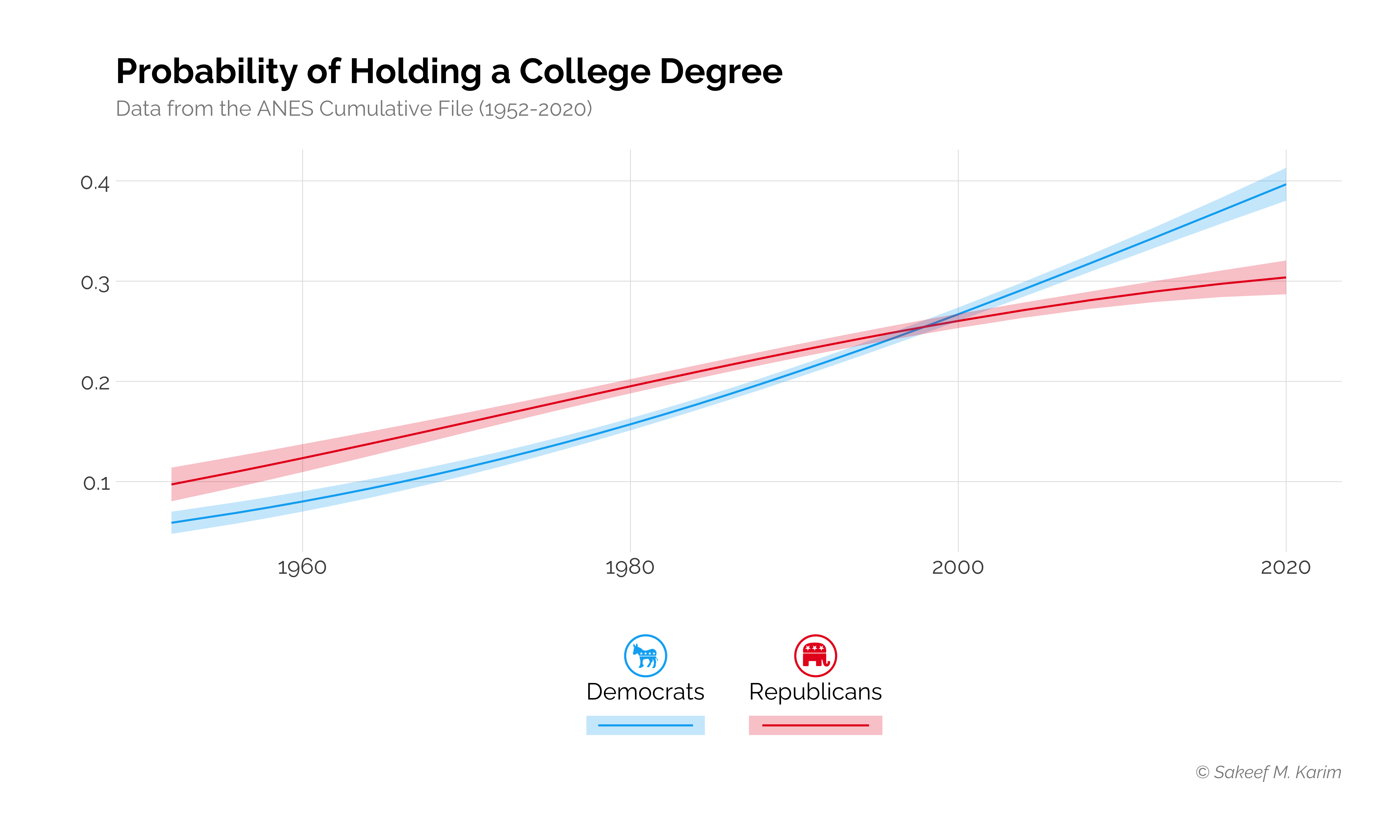
The Macro Context
Click to Expand Image & Launch Gallery
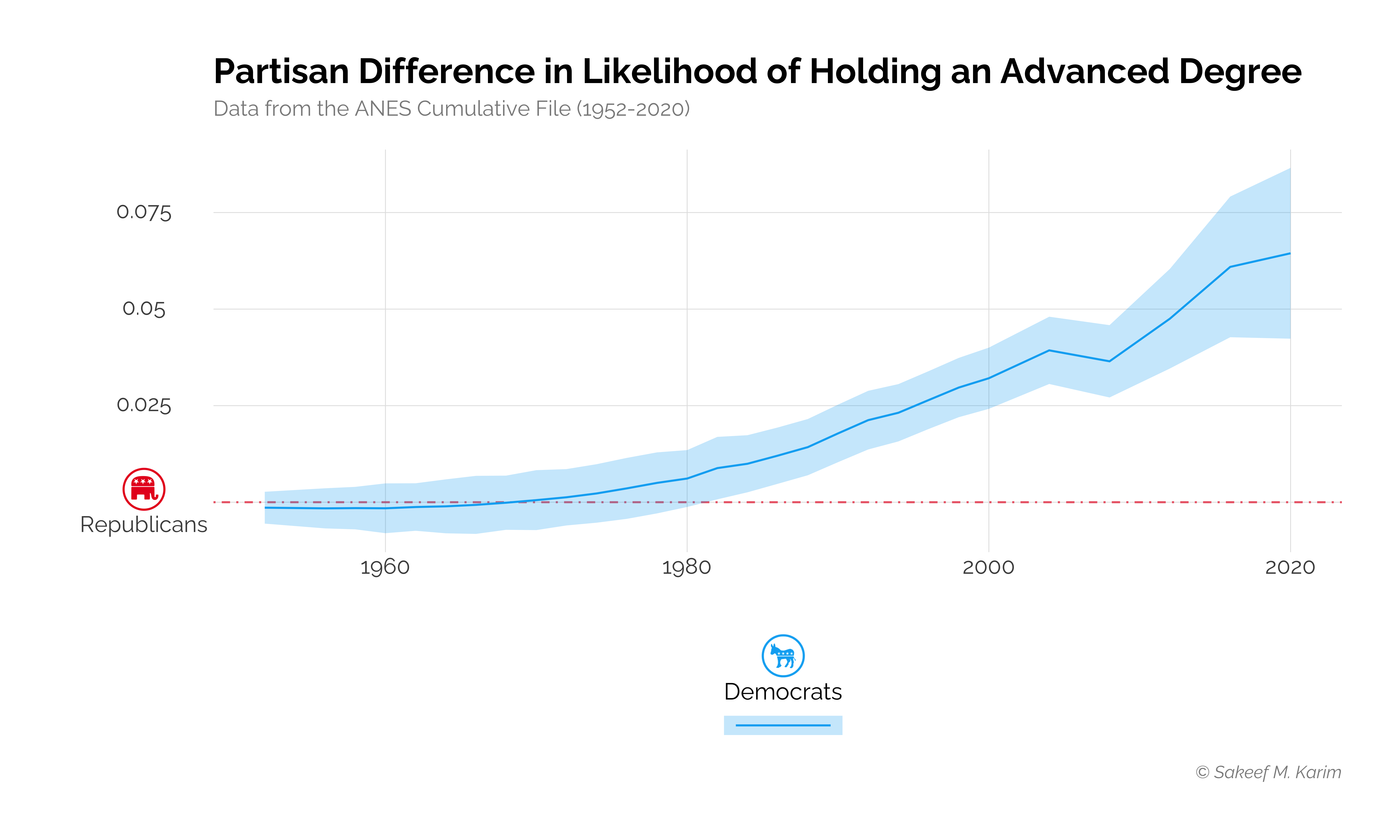
The Macro Context
Click to Expand Image & Launch Gallery
Group Discussion III
Implications of the New Realignment
In your view, why might this educational realignment matter?
Discuss in groups of 3-4.
Cultural Cleavages
College and Culture
The importance of cultural considerations in the minds of voters has grown enough over the past two decades to unmoor the degree-holding segment of the public from its traditional home in the Republican Party while dramatically extinguishing the Democrats’ former advantage among white citizens of lower educational status. Because Americans are likely to work with, socialize with, partner with, and live near people of similar educational attainment to themselves, the diploma divide will likely reinforce existing trends toward greater social and affective polarization.
(Grossmann and Hopkins 2024, 8, EMPHASIS ADDED)
College and Culture
Though they may sometimes be stoked by calculating politicians and outrage-baiting media personalities, today’s cultural battles reflect the genuine emotional engagement of many citizens with the revolutionary changes in social norms, mores, and hierarchies that have occurred over their lifetimes. In an age when subjects as previously unremarkable as consumers’ choice of transportation, recreational activity, entertainment genre, light beer, or fast-food outlet can serve as charged forms of political expression - or be interpreted as such by others - it is hard to deny that a culture war has erupted.
(Grossmann and Hopkins 2024, 10–11, EMPHASIS ADDED)
College and Culture
Three Quick Questions
Just to be sure, let’s tackle three quick questions:
How are the “cultural battles” invoked by Grossmann and Hopkins (2024) related to educational realignment?
How can we connect Grossmann and Hopkins’ (2024) ideas to DellaPosta’s (2020) oil spill model?
Is the educational cleavage described by Grossmann and Hopkins (2024) unique to the United States?
College and Culture
The political dynamics in the United States and comparable Western democracies have evolved as their populations have become more educated, diverse, and internationally connected … The global left has become more assertive in adding a progressive cultural agenda to its traditional support for an expanded welfare state, while the global right has accommodated an increasingly energetic backlash against social change and the growing power of technocratic bureaucracy in domestic and international institutions. These trends have contributed to an emerging dimension of conflict along educational lines, which reinforces the rising centrality of cultural issues.
(Grossmann and Hopkins 2024, 11–12, EMPHASIS ADDED)
College and Culture
As citizens have become more educated, younger generations have prioritized the progressive “postmaterial” cultural values Inglehart first described a half-century ago, incentivizing leftward social and political change. The rising salience of cultural beliefs and associated social policy issues has coincided with a more educated society and a leftward shift in norms. Among older and less educated voters, these developments have stimulated antagonism against societal diversification and the rule of the well-educated.
(Grossmann and Hopkins 2024, 12, EMPHASIS ADDED)
College and Culture
The postmaterialist turn reshaped political fields in advanced democracies—often leading to the fragmentation of party systems and the emergence of new left and radical right parties.
An Important Question
Did this party fragmentation take root
in the United States, too?
Group Exercise
College and the “Culture War”
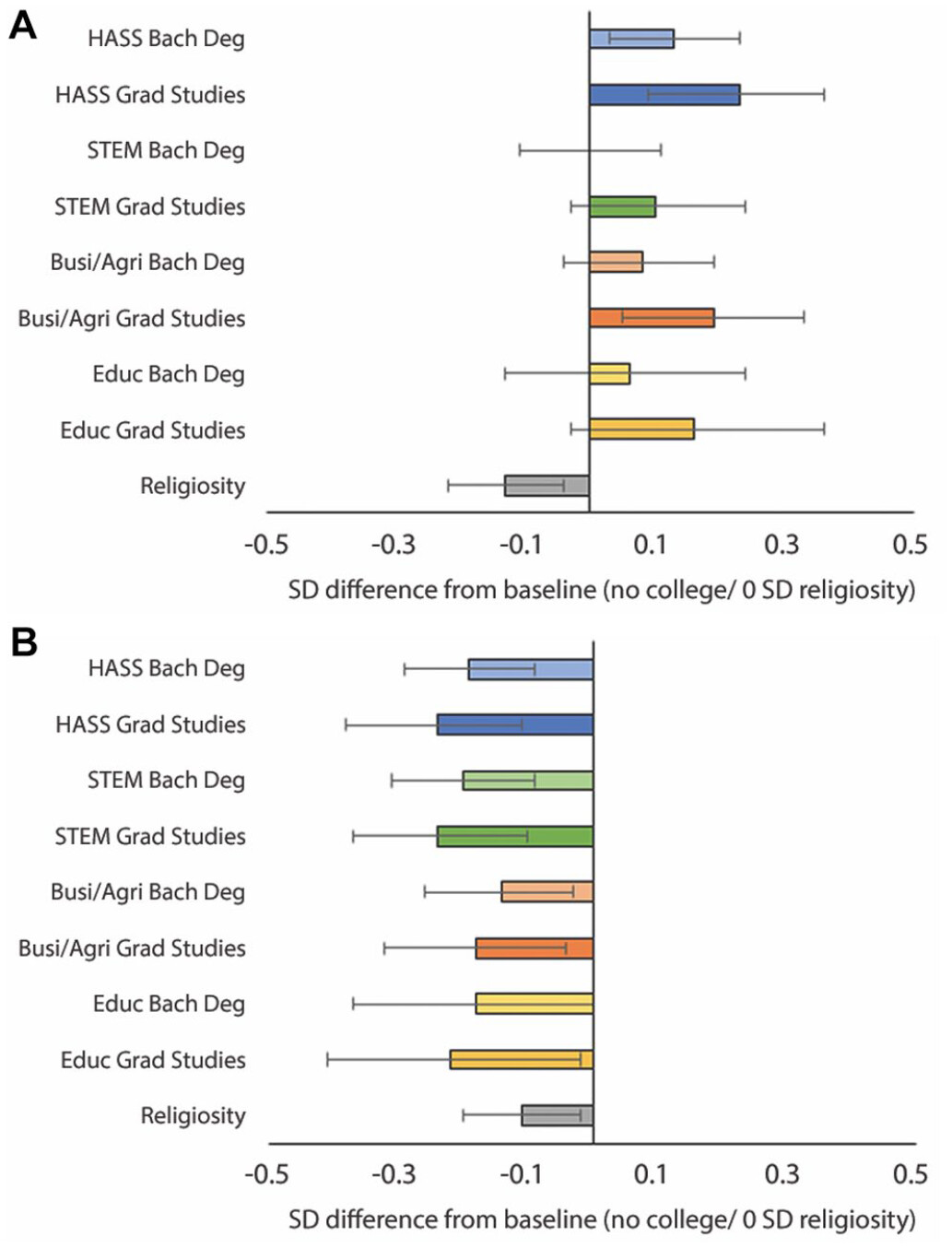
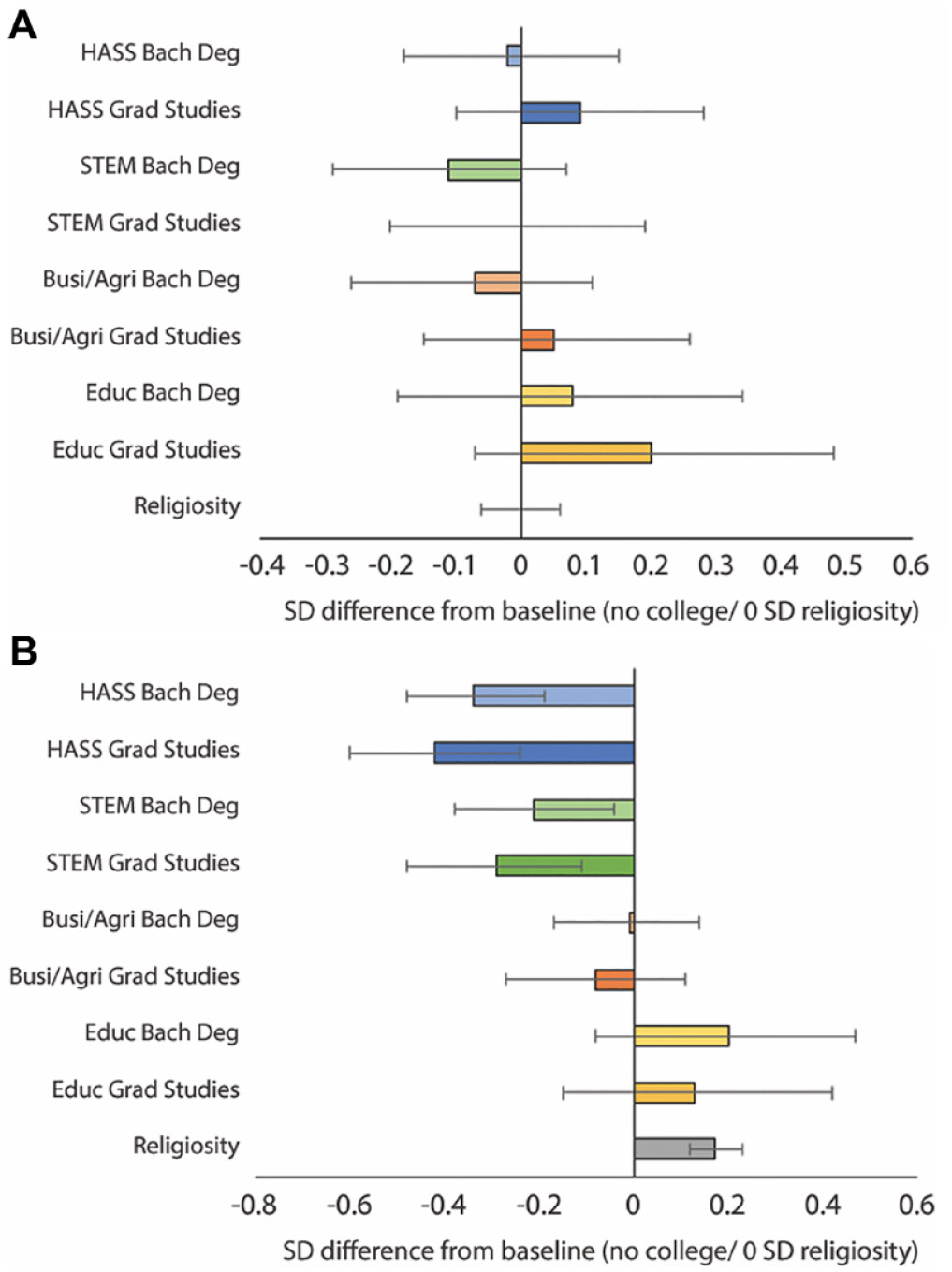
Click on the image below to view and cycle through the first three
figures from Broćić and Miles (2021).
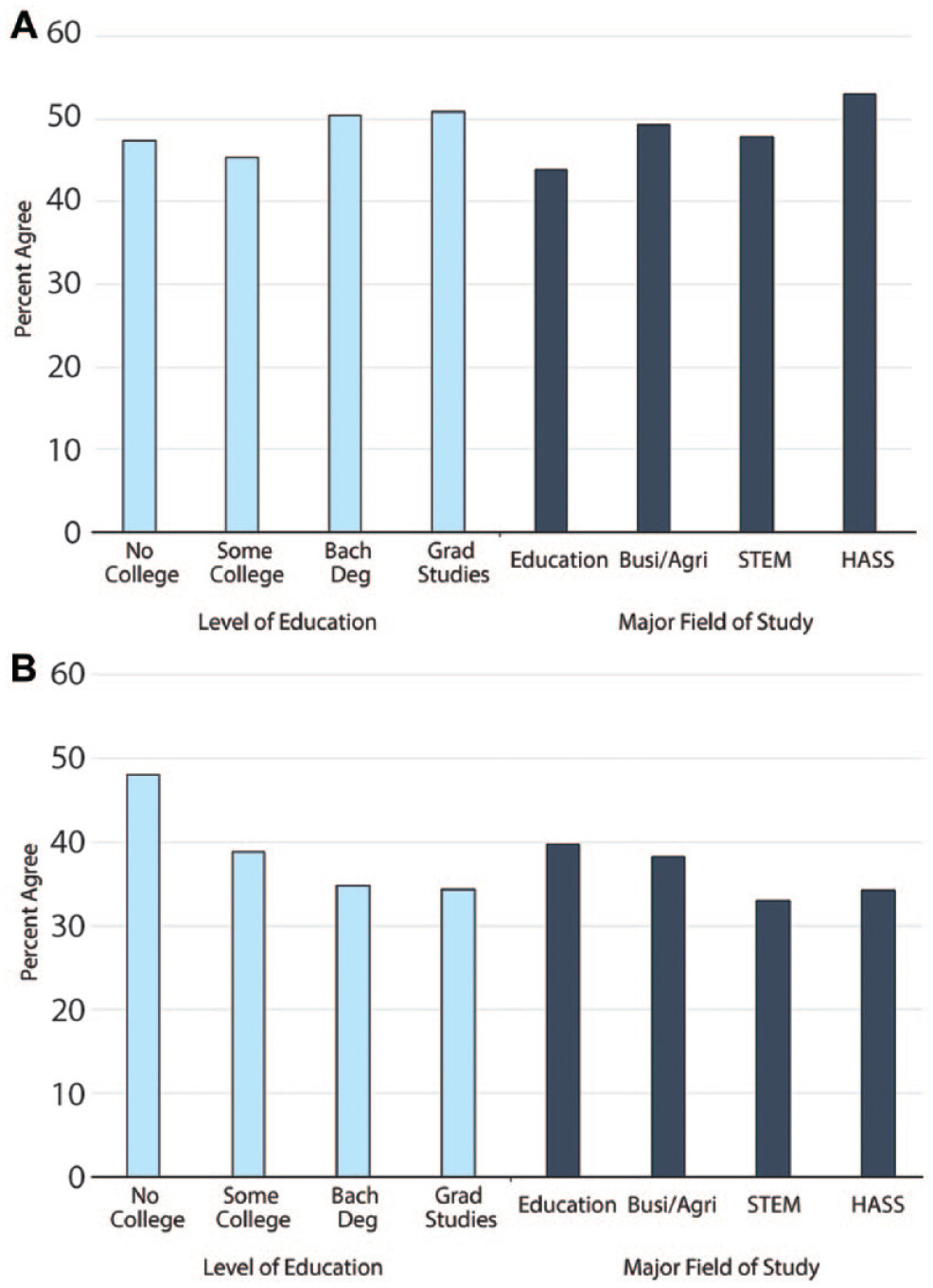
Figure 1 from Broćić and Miles (2021).
What do these figures reveal? According to the authors, how do these findings contribute new insights into how higher education undergirds
moral conflict in America? Discuss in groups of 2-3.
Group Discussion IV
Is There a “Culture War?”
Not everyone agrees that we’re in the throes of a culture war.
In groups of 2-3, draw on Nwanevu (2022) or Baldassarri and Park (2020) to explain why.
Then, discuss what you think. Is there an ongoing “culture war?” Does this concept or motif help you understand populism, authoritarianism or other phenomena we’ve covered in class?
Enjoy the Weekend
References
Note: Scroll to access the entire bibliography